这节课,我们将使用图灵机来解决真实的问题。
DFAs的接受问题
令 ADFA=⟨B,w⟩∣B is a DFA and B accepts w,证明 ADFA 是图灵可判定的。
证明:构造一个图灵判定器 DA−DFA 来判定 ADFA,下面是对 DA−DFA 的描述:
DA−DFA=“On input s1. Check that s has the form ⟨B,w⟩ where B is a DFA and w is a string; reject if not.2. Simulate the computation of B on w.3. If B ends in an accept state then accept. If not then reject.”
相信大家都能看懂 DA−DFA 是如何判定 ADFA 的。由于 DFA 肯定能在有限时间内给出结果,因此 DA−DFA 总是能停机。
考虑到大家可能会疑惑 DA−DFA 长什么样,为了让大家更加理解,我们给出下面这张图来可视化这个 DA−DFA。
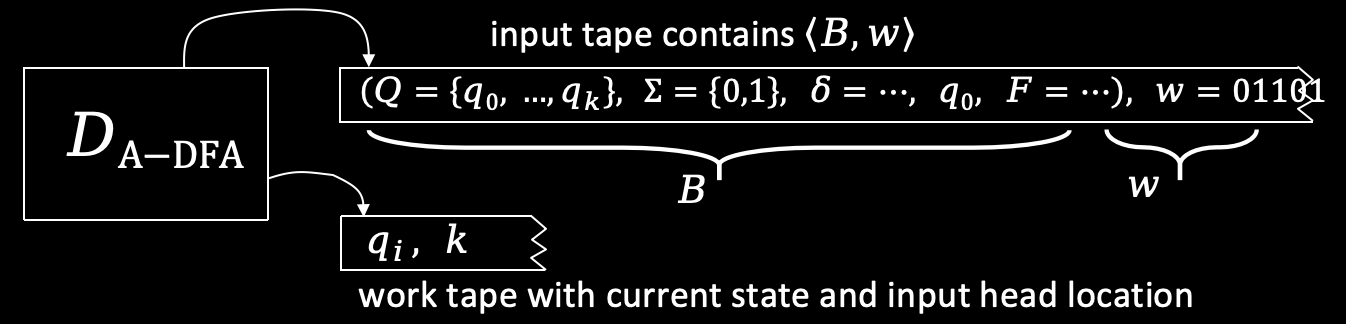
可以看到,B 是以一个 DFA 的标准形式化定义给出的,⟨B,w⟩ 就是把 B 的形式化定义和 w 拼接到一起组成了一个字符串。DA−DFA 运行时就根据这个字符串模拟出这样一个 B。此外,我们知道为了模拟一个 DFA 的运行,还需要记录当前状态和头指针在 w 上的位置,于是我们再加一个纸带记录这两个信息,这无伤大雅,毕竟我们已经知道多带图灵机和单带图灵机是等价的。
NFAs的接受问题
令 ANFA=⟨B,w⟩∣B is a NFA and B accepts w,证明 ANFA 是图灵可判定的。
证明思路和 DFAs 的接受问题是一模一样的,但有一点细微的差别。注意 NFA 中存在着 ϵ-转移,这可能会使得 NFA 陷入无限循环,导致构造出的图灵机 DA−NFA 无法停机。解决方法其实是很简单的,将 NFA 转换为 DFA 就行了。
构造一个图灵判定器 DA−NFA 来判定 ANFA,下面是对 DA−NFA 的描述:
DA−NFA=“On input s1. Convert NFA B to equivalent DFA B′.2. Check that s has the form ⟨B,w⟩ where B is a NFA and w is a string; reject if not.3. Simulate the computation of B′ on w.4. If B′ ends in an accept state then accept. If not then reject.”
实际上还能再简单一点,我们可以看到 2、3、4 步其实和之前的 DA−DFA 是一样的,因此我们可以这么做:
DA−NFA=“On input s1. Convert NFA B to equivalent DFA B′.2. Run TM DA−DFA on input ⟨B′,w⟩.3. Accept if DA−DFA accepts.Reject if not.”
将另一个图灵机作为子程序在图灵机中进行调用是完全合法的,要习惯这种用法,这将对我们解题提供极大便利。
DFAs的空集问题
令 EDFA=⟨B⟩∣B is a DFA and L(B)=∅,证明 EDFA 是图灵可判定的。
这个问题其实就是在问我们如何判定一个 DFA 所能识别的语言是空语言。DFA 中是没有 ϵ-转移的,所以,只要 DFA 中存在着从初始状态到接受状态的路径,那 L(B) 就肯定不为空;反之,如果不存在这样一条路径,L(B) 就为空。要检查是否存在这样的路径,就要用到路径搜索算法了。路径搜索算法可太多了,我们这里选择 BFS 作为示例。下面是我们构造的图灵判定器 DE−DFA:
DE−DFA=“On input ⟨B⟩1. Mark start state.2. Repeat until no new state is marked:Mark every state that has an incoming arrow from a previously marked state.3. Accept if no accept state is marked.Reject if some accept state is marked.”
考虑这样一个问题:我们是否可以选择将所有可能的字符串都输入 B,来检测 L(B) 是否为空?答案是不行。因为我们这里是要证明 EDFA 是图灵可判定的,而这种方法会使得 DE−DFA 可能无法停机,那就无法证明 EDFA 是图灵可判定的了。
DFAs的等价问题
令 EQDFA=⟨A,B⟩∣A and B are DFAs and L(A)=L(B),证明 EQDFA 是图灵可判定的。
这是一个有趣的问题。解决这个问题可以用到我们之前所说的调用子程序图灵机的思想,至于是哪个图灵机,这里给个提示:就是上面的 DE−DFA。希望大家先自己想一想。
我们的思路是这样的:如果 L(A)=L(B),那么 L(A) 和 L(B) 的对称差(两个集合不相交的部分)应该为 ∅,所以我们去构造一个 DFA C,并且 L(C)=(L(A)∩L(B))∪(L(A)∩L(B))。那下一步就只需要调用 DE−DFA 来检测 C 是否识别的是空语言就好了。
下面给出我们构造的图灵判定器 DEQ−DFA:
DEQ−DFA=“On input ⟨A,B⟩1. Construct DFA C where L(C)=(L(A)∩L(B))∪(L(A)∩L(B)).2. Run DE−DFA on ⟨C⟩.3. Accept if DE−DFA accepts.Reject if DE−DFA rejects.”
🏹练习:令 EQREG=⟨A,B⟩∣A and B are REs and L(A)=L(B),能否证明 EQREG 是图灵可判定的?这道题的答案显而易见,我们已经知道了正则表达式和 DFA 是等价的,既然我们能解决 DFAs 的等价问题,那么正则表达式的等价问题也能迎刃而解。
CFGs的接受问题
令 ACFG=⟨G,w⟩∣G is a CFG and w∈L(G),证明 ACFG 是图灵可判定的。
事实上,要证明这件事还真不是件容易的事情。一个 CFG 中可能存在无穷无尽的推导路径,如果要去枚举每一种可能,那么我们构造出的图灵机就不可能停机。
要解决这个问题,我们需要认识一个概念——乔姆斯基范式(Chomsky Normal Form, CNF)。CNF 只允许出现下面这两种形式的规则:
AB→BC→b
CNF 保证了:
- 📜引理 1:任何一个 CFG 都可以转换成 CNF。
- 📜引理 2:如果 H 是一个 CNF 并且 w∈L(H),那么每个对 w 的推导的长度都是 2∣w∣−1 步。
让我们来关注引理 2。我们不需要知道为什么会有 2∣w∣−1,我们只需要知道它给出了对推导路径长度的限制,这使得遍历所有的推导成为可能。CNF 中,每一步推导只有有限的可选规则,而总推导步数已经被限制成固定值 2∣w∣−1,这就变成了一个遍历“有限深度、有限分支的树”问题,因此推导路径是可枚举的。
下面给出构造的图灵判定器 DA−CFG:
DA−CFG=“On input ⟨G,w⟩1. Convert G into CNF. 2. Try all derivations of length 2∣w∣−1.3. Accept if any generate w.Reject if not.”
这里我们还能给出一个推论:每一个 CFL 都是图灵可判定语言。
这一点其实是很直观的。我们说 CFL 的定义就指出了:假设 A 是一个 CFL,那么一定存在一个 CFG G 能生成 A。使用这个 G,我们就能构造的图灵判定器 MG 来判定一个字符串是否属于 CFL A:
MG=“On input w1. Run DA−CFG on ⟨G,w⟩.2. Accept if DA−CFG accepts.Reject if it rejects.”
这里你可能会疑问,我们如何找到这个 G?答案是找不到,我们也不需要关注找不找的到,我们只需要关注其存在性即可。
出于同样的原因,我们可以得到结论:APDA 肯定也是图灵可判定的,因为 PDA 和 CFG 是等价的。
CFGs的空集问题
令 ECFG=⟨G⟩∣G is a CFG and L(G)=∅,证明 ECFG 是图灵可判定的。
要去检查一个 CFG 是否生成空语言,其实就看它最终能否把开始变量替换为终结符。要验证这一点,我们可以从终结符开始倒推:首先标记 CFG 中全部的终结符,假设非终结符 A 能产生终结符 a,那么就将 A 进行标记,被标记的非终结符也可以视作终结符,然后继续向前标记。如果最终 CFG 中的开始变量未被标记,那就说明 CFG 生成的是空语言,否则不是。
下面给出构造的图灵判定器 DE−CFG:
DE−CFG=“On input ⟨G⟩1. Mark all occurrences of terminals in G.2. Repeat until no new variables are marked:Mark all occurrences of variables A ifA→B1B2…Bk is a rule and all Bi were already marked.3. Reject if the start variable is marked.Accept if not.”
CFGs的等价问题
令 EQCFG=⟨G,H⟩∣G and H are CFGs and L(G)=L(H),能否证明 EQCFG 是图灵可判定的?
思路有两种,一种是找到 G 和 H 对应的 PDA,然后分别把对方的字符串输入进对方的 PDA,看是否能完全接收,但这样的话图灵机就不可停机了,因此这条路不行;另一种思路是效仿 DFAs 的等价问题的思路,我们去构造对称差,但可惜的是,CFL 在交集和补集的运算下是不封闭的,这导致我们无法用同样的思路去证明。那怎么办?
直接给出结论:EQCFG 是图灵不可判定的。具体的证明我们将在下节课给出。
不仅如此,判断一个 CFG 是否具有二义性也是不可判定的。可能大家原本都以为 CFG 是一个很简单的东西,但没想到在这些问题上它居然这么棘手。
TMs的接受问题
令 ATM=⟨M,w⟩∣M is a TM and w∈L(M),能否证明 ATM 是图灵可判定的?
ATM 也是图灵不可判定的,关于这一点的证明将在下节课给出。但是值得注意的是,虽然它是图灵不可判定,但它却是图灵可识别的,下面让我们来尝试证明这一点。
下面的图灵识别器 U 能识别 ATM:
U=“On input ⟨M,w⟩1. Simulate M on input w.2. Accept if M halts and accepts.3. Reject if M halts and rejects.4. Reject if M never halts.”
这就是用一台图灵机模拟另一台图灵机的例子。但是注意,Michael Sipser 教授指出我们不应该在图灵机的算法里写“如果图灵机没有停机,那也拒绝”这种话(U 中的第 4 步),因为图灵机的停机问题是不可判定的,我们没办法知道图灵机是还未跑出结果,还是在不断循环。正确的写法是“如果 M 卡死/循环,U 也永远循环”。
课后题
A. 假设 C 是一种语言。证明 C 是图灵可识别的,当且仅当存在一个图灵可判定的语言 D 使得 C=x∣∃y,⟨x,y⟩∈D。
先证明:存在一个图灵可判定的语言 D 使得 C=x∣∃y,⟨x,y⟩∈D ⇒ C 是图灵可识别的。要证明这一点,我们就要构造一个图灵机 RC 来识别 C。假设 DD 是 D 的判定器。注意这里的 y 是可以枚举的,这将是我们的切入点:
RC=“On input w1. For all y∈Σ∗, simulate DD on input ⟨w,y⟩,until DD halts and accepts some y.2. Accept if DD halts and accepts.”
下面证明:C 是图灵可识别的 ⇒ 存在一个图灵可判定的语言 D 使得 C=x∣∃y,⟨x,y⟩∈D。我们要构造一个图灵判定器来识别 D,也就是要构造一个图灵可判定的语言 D 能和 C 满足这样的关系,这里面的难点在于如何让图灵机停机。其实可以直接把 y 设定为运行时间,说如果 y 步内运行出来了就接受,否则就拒绝,那就保证了一定能跑出结果,因此,假设 RC 是识别 C 的图灵识别器,我们可以这样构造 D 的判定器 DD:
DD=“On input ⟨x,y⟩1. Simulate RC on input x within y steps,2. Accept if RC halts and accepts.3. Reject if RC halts and rejects.4. Reject if RC does not halt within y steps.”
B. 令 E=⟨M⟩∣M is a DFA that accepts some string with more 1s than 0s,证明 E 是图灵可判定的。(提示:CFL)
使用 CFG 可以构造一个文法来生成 1 比 0 多的字符串,并令对应的语言为 A。若 M 能识别 1 比 0 多的字符串,那肯定有 A∩L(M)=∅,另外,正则语言和 CFL 的交集仍然是 CFL(见 Lecture 5),也就是说,问题转变为了判断 CFL 是否为空,我们可以用到之前的构造 DE−CFG。我们可以构造图灵判定器 DE 来识别语言 E:
DE=“On input ⟨M⟩1. Simulate DE−CFG on input ⟨G⟩ where L(G)=A∩L(M).2. Accept if DE−CFG halts and accepts.3. Reject if DE−CFG halts and rejects.”